
Gastroenterology
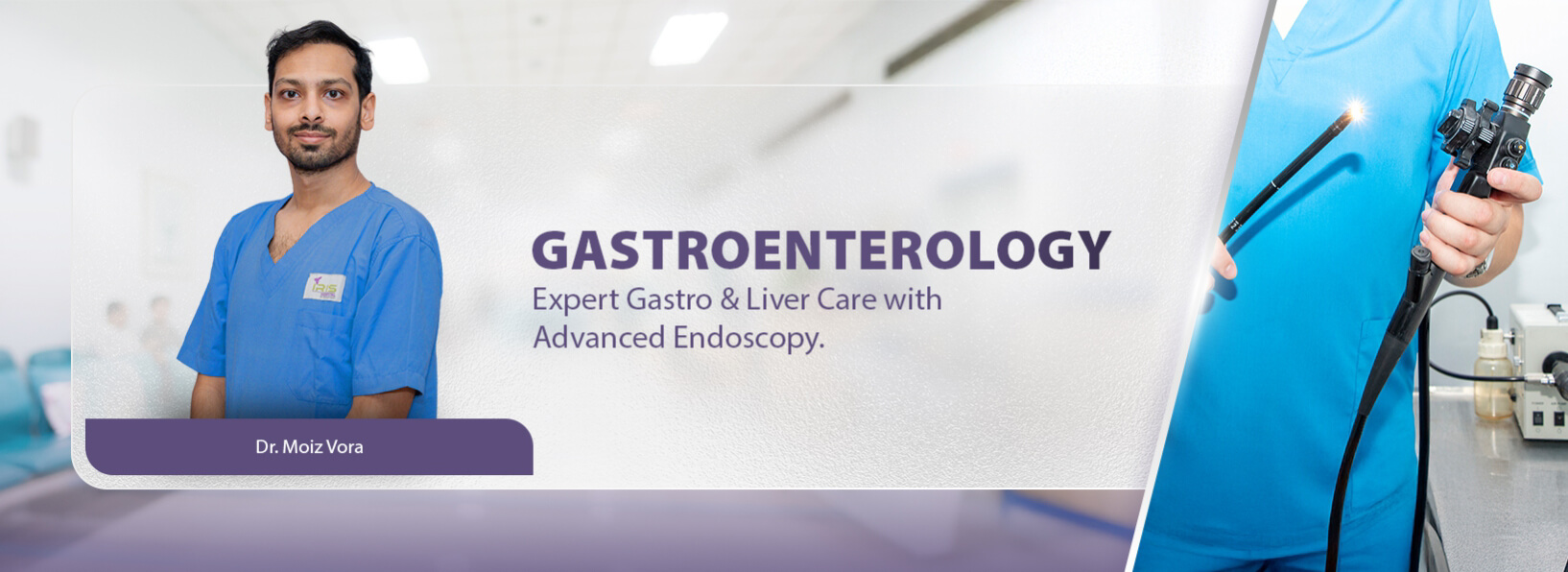
Gastroenterology | IRIS Hospital
Monday to Saturdays
10 am to 1pm
3pm to 7 pm
Phone: 02692-288234 (by Appointments)
Brief Overview of The Department
As a super-specialty involves management of patients suffering from disorders of digestive system and liver. These patients may be suffering from simple problems like indigestion, bloating, constipation, pain in abdomen, diarrhoea, jaundice or difficult problems like blood in the vomiting or stools, liver failure, cirrhosis, ascites, bile duct stones, cancers of gall bladder, pancreas, food pipe, stomach or intestine.
The mission of the Department of Gastroenterology at Iris Hospital is:
To provide an exceptionally high level of clinical care and emergency services to the patients suffering from diseases of digestive system and liver,
To provide comprehensive care which includes multidisciplinary approach by highly skilled team of Gastroenterologist, GI & HPB surgeon, Interventional Radiologist and Oncologist
To do cutting edge clinical and translational research in the field of Gastroenterology and Hepatology
To take initiative in increasing awareness among public of Charotar Belt in preventive aspects of gastrointestinal and liver diseases.
Department Specializes In
Acute Or Chronic Hepatitis (Hepatitis A / E / B / C)
Fatty Liver
Cirrhosis Of Liver and Liver cancer
Ascites (Accumulation of Fluid In The Abdomen)
Difficulty in swallowing
Repeated vomiting / chest pain
Gall stone
Chronic Diarrhoea
Gastric Ulcers
Blood In Stools / Vomit
Frequent Abdominal Pain
Loss Of Weigh
Yellowing Of Eyes
Ulcerative Colitis / Crohn’s Disease
Abdominal Tuberculosis
Acute / Chronic Pancreatitis
Food Allergy
Paediatric Constipation / Repeated Abdominal Pain / Diarrhoea
Colon and pancreas / Gall Bladder cancer
Facilities Provided By The Department
Advanced gastrointestinal endoscopy services, both diagnostic and therapeutic
Upper GI endosco
Colonoscopy
Sigmodoscopy
Capsule endoscopy
Endoscopic variceal ligation
Endoscopic sclerotherapy and glue injection
Stenting and dilation for esophageal and colonic strictures (both benign and malignant)
Achalasia cardia endoscopic dilatation
Removal of intestinal polyp (polypectomy)
Foreign body removal
Percutaneous endoscopic gastrostomy (PEG) placement for feeding patients with swallowing difficulty
Naso-jejunal tube placement for feeding of critically ill patients
Piles banding
Advanced biliary and pancreatic endoscopy services
Endoscopi retrograde cholangio-pancreaticography (ERCP)
Stenting for benign and malignant biliary and pancreatic duct strictures
Endoscopic treatment for pancreatic pseudocyst
Fibroscan of Liver
Transient elastography (Fibroscan) of liver for non-invasive diagnosis of liver fibrosis
Liver biopsy
Percutaneous liver biopsy
Trans-jugular liver biopsy
Treatment for liver cancer
Radio-frequency ablation (RFA)
Trans-arterial chemo-embolization (TACE)
Pre- and post-liver transplantation services
Pre-liver transplant recipient and donor work-up
Post-liver transplant Hepatology services
Inpatient Services Of The Department
Different facilities available include general ward (separate for male & female patients), private – single (with and without AC) & deluxe rooms and suite rooms.
Fully equipped ICU facilities
Fully equipped Trauma & Emergency centre
In house advanced laboratory services
FAQs
How do I prepare for a colonoscopy?
Preparation for a colonoscopy requires laxatives. A powder will be prescribed to you which will be reconstituted in 2 lit of water. The entire preparation is to be consumed within 2 hours. Alternatively, for early morning procedures, a split preparation is possible whereby half the dose is taken the previous night and half in the morning. This medication will result in loose motions over 5-8 times. This is the desired effect and will lead to expulsion of all the stools from the colon and will allow clearer visualization during the procedure. It is preferable to consume semi solid and a soft diet 1 day prior to the procedure.
Departments